
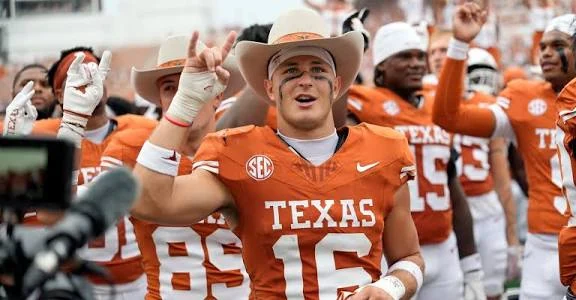
You do not need a complete knowledge of Texas football history to enjoy your first game. The traditions make sense gradually: a hand signal repeated across generations, the crowd recognizing the band, a live mascot becoming the center of attention, and a familiar color making strangers look like part of the same gathering. Learning a little background helps you notice what is happening without turning Saturday into a memory test.
The most useful approach is to separate history from the current itinerary. Official tradition pages explain where particular customs came from. The game-day schedule tells you when a parade, performance, or other activity is taking place now. This guide brings those two kinds of information together while leaving room for a new fan simply to observe. Belonging at a game does not require knowing every name, story, or cue before you arrive.
Start with the Hook 'em Horns signal
Texas Athletics traces the hand signal to head yell leader Harley Clark in 1955. Its account describes a demonstration at a Gregory Gym rally before the TCU game, followed by its spread through the stadium. That is a specific origin story worth learning from the university's history rather than from a shortened version that changes with each retelling.
The gesture's appeal is easy to understand even without knowing the date. It gives people a way to recognize the same affiliation without a long explanation. At a game, in a photograph, or among friends following from elsewhere, a small movement carries a shared reference. New fans can learn the gesture while also learning the story. There is no need to turn that knowledge into a test of who is a real supporter. Traditions become more welcoming when people explain them generously.
Understand why Bevo is more than a logo
The Longhorn image appears throughout the university's sporting identity, but Bevo is a live mascot with a documented history. Texas Athletics connects the first appearance to the Thanksgiving game against Texas A&M in 1916. Its fuller account is a better source than a convenient anecdote repeated without checking the dates.
For a visitor, the live presence adds something a printed mark cannot: a sense that a familiar symbol exists in the same physical place as the crowd. Respect the official arrangements around any appearance and follow staff directions. Do not assume a photograph opportunity allows approaching an animal or moving beyond a boundary. Enjoying the tradition includes letting the people responsible manage it. If seeing Bevo is a priority, check the current game-specific information rather than promising a child an encounter that has not actually been announced.
Listen for how the band changes the occasion
Inside a stadium, music is part of how the crowd experiences time. It can mark arrival, build anticipation, respond to a moment, or gather attention after a break. You do not need to know every selection to notice the difference between watching a television feed and hearing a live band with the people around you.
If the band is one of your priorities, plan to reach the seat with enough time for the official pregame sequence. Do not assume the only important moment is kickoff. Watch how spectators respond and ask a companion about an unfamiliar cue during a natural pause. If you want historical details about a particular piece or practice, use the university's official tradition resources. The experience can be immediate and enjoyable while the background knowledge grows over several visits rather than arriving all at once.
Let the color connect the crowd
Burnt orange is one of the first things a newcomer notices because it links clothing, flags, signs, and the university's visual identity. Wearing team colors can be a simple way to participate, but it should not become a reason to judge someone else's wardrobe or spending. A guest does not need a new collection of merchandise to enjoy the afternoon.
Choose clothing for the actual conditions and your comfort first. If buying something, make it a deliberate purchase that fits the budget rather than a hurried obligation. A favorite shirt can become part of a person's own game-day routine over time. The meaning comes from the memories attached to it, not from how recently it was bought. For families, letting a child choose one small expression of support may be more enjoyable than trying to reproduce every adult's full match-day outfit.
See pregame as a collection of choices
Texas Athletics describes Bevo Blvd as a central pregame gathering area, with activities including the Bevo Parade and Stadium Stampede. Read the actual game's schedule for timing and details. Those names help you identify possibilities; they do not mean you must include every event in a single visit.
Choose what matters to you and leave a clear boundary for stadium entry. A person who prefers watching the band from the seat can have a different routine from someone who enjoys the outdoor gathering. Neither approach misses the point of supporting the team. Our first-game guide explains how to build a manageable arrival around two priorities. The tradition becomes easier to appreciate when the plan leaves room to notice it rather than constantly moving toward the next thing on an overcrowded checklist.
Learn stories without treating every version as fact
Sports history is full of memorable anecdotes, and a tidy story can travel farther than a careful correction. When a claim includes a precise date, origin, or explanation, check the original institutional history or another reliable primary source before presenting it as settled. Repetition does not make an account more accurate.
It is perfectly fine to say that you have heard a story but have not verified it. That distinction can lead to an interesting conversation rather than shutting one down. For a family, looking up a tradition together after the game can become part of the experience. The history page is a starting point, while official university resources provide fuller background. Knowing where a story comes from allows you to enjoy it without accidentally passing along an invented detail as part of the program's record.
Give newcomers room to participate differently
Some fans sing immediately, others watch quietly, and others need a few visits before the cues feel familiar. Explain rather than correct aggressively. If someone asks what is happening, a short answer during a pause is usually more useful than a long account while a play is underway.
Guests may have different reasons for attending: family, friendship, curiosity, a connection to the university, or an interest in the sport itself. Those reasons can all lead to meaningful participation. Respect personal choices about particular customs and keep the focus on enjoying the event together. The family game-day guide makes a similar point about children's pace. A welcoming atmosphere lets someone form their own relationship with Texas football rather than feel they are completing an entrance examination before earning the right to enjoy a Saturday.
Let a personal routine develop naturally
Over time, a small repeated choice can become your own game-day tradition: the friend you call, the photograph you take, or the way you review the schedule together. It does not need an official history to matter personally. Keep that distinction clear when writing or talking about it: a family ritual is meaningful without being a university-wide custom.
Choose routines that remain enjoyable and practical. If a favorite meeting point becomes unsuitable or the group changes, adapt without feeling that the whole experience has been lost. The people and the shared football are the important continuity. A tradition that creates unnecessary pressure can be simplified. A modest habit repeated happily over several seasons may become more valuable than a complicated itinerary copied from somebody else's account of the perfect game day.
Leave with one story you understand better
After a first visit, choose one thing you want to learn more about. It might be the hand signal, Bevo's history, a band moment, or the setting of a rivalry. Follow the official source and share the useful detail with the person you attended with.
That is enough progress for one Saturday. Traditions are learned through repeated experiences and conversations, not memorized all at once. A little verified history adds depth, and a considerate attitude makes the occasion easier to share. The rest can grow naturally the next time Texas takes the field and the crowd gathers around the same familiar signs.
Sources and review date
Last reviewed October 29, 2026. Use the linked official sources for event-specific announcements, rules, and availability.
Frequently asked questions
Where did the Hook 'em Horns hand signal come from?
Texas Athletics credits head yell leader Harley Clark with introducing it in 1955, including its demonstration at a Gregory Gym rally before the TCU game.
Do I need to know every tradition before attending?
No. Watch, ask questions, and participate at your own pace. Use official histories for background and the game-specific timetable for scheduled activities.
This independent fan website is not affiliated with Texas Athletics.